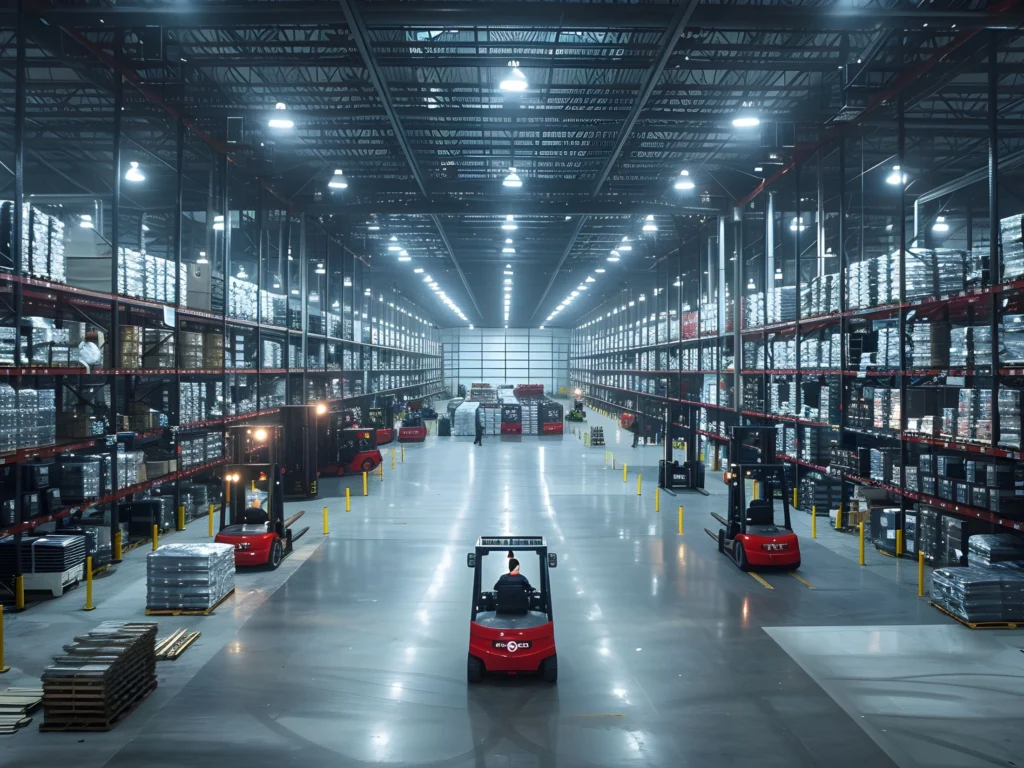
AutoScheduler has introduced a new warehouse app builder aimed at enhancing the efficiency of logistics teams by enabling them to create custom tools derived directly from live facility data. This software module is part of the broader Warehouse AI Platform designed for distribution centers that require a balance of inventory, machinery, and labor management. Traditionally, […]

Gartner Reveals Four Tiers of AI in Warehouse Automation: A Comprehensive Breakdown
Gartner has published an analysis highlighting the evolution of warehouse automation into four distinct operational AI tiers. This shift reflects a growing trend among logistics operators as they transition from trial software models to implementing live systems in their facilities. According to the research, there are three main pressures prompting this significant change within the […]
Optimizing Supply Chain Allocation: How Palantir Foundry and cuOpt Leverage NVIDIA Technology
NVIDIA is leveraging Palantir Foundry and cuOpt to enhance its hardware supply chain allocations across global manufacturing sites. The focus is on improving operational delivery from the point of wafer output to the first token, with the process subdivided into time-to-rack and time-to-token intervals. Managing Component Flows With advancements in hardware scaling, NVIDIA faces increasing […]
How AI Agents Accelerate Response Times in Slow-Acting Supply Chains
Supply chain disruptions cost businesses around $184 billion in 2025, according to the J.S. Held Global Risk Report. Despite improvements in detection speeds, the problem remains that organizations often struggle to act quickly on the issues identified. Traditionally, tools such as visibility platforms, control towers, risk scores, and digital twins have revolutionized the way supply […]
CloudNC’s Vision: Accelerating AI-Driven Supply Chain Machining
CloudNC has raised $20 million to enhance its AI-driven precision machining technology in global supply chains. The funding round, led by Nimble Ventures and supported by Calculus Venture Capital, Entrepreneur First, and Lockheed Martin’s LM Ventures, will allow CloudNC to scale its operations. Founded in 2015 and based in London, CloudNC aims to address the […]
OneRail Leverages Nvidia AI for Real-Time Optimization of Last-Mile Delivery
OneRail has introduced an innovative AI delivery platform called OmniSTAR, leveraging Nvidia technology to optimize last-mile delivery for retailers, wholesalers, and distributors. The system analyzes various delivery options—such as in-house fleets, couriers, and parcel carriers—to identify the most cost-effective method that meets the desired service level. OmniSTAR integrates Nvidia’s cuOpt decision optimization engine and cuDF […]
SenseTime’s Galaxy Project: Scaling Up Domestic AI Chips for the Future
SenseTime has initiated the Galaxy Project to enhance domestic AI chip infrastructure in China through collaboration with nearly 20 partners. In a keynote address titled “Intelligent Transformation and Symbiosis,” co-founder Yang Fan outlined a comprehensive approach connecting chip-level technology with partnerships and commercial deployment, resulting in domestically-produced AI computing power. As part of the Galaxy […]
Unpacking the Mathematics Behind the OpenAI Jalapeño Chip
OpenAI’s financial success is closely tied to managing its infrastructure costs, prompting the creation of the new OpenAI Jalapeño chip. This custom chip, developed with Broadcom, is an application-specific integrated circuit (ASIC) aimed at reducing substantial expenses associated with using third-party hardware. Currently, Nvidia dominates the market with a staggering profit margin of 75% on […]
Humanoid Robots: The Rise of Physical AI in Manufacturing Environments
British technology firm Humanoid is set to deploy humanoid robots in collaboration with Schaeffler, a German industrial supplier, for use in their factories. According to reports, this partnership anticipates the introduction of between 1,000 and 2,000 robots across Schaeffler’s manufacturing locations by 2032, with the first deployment scheduled between December 2026 and June 2027. The […]
Navigating Governance: The Impact of Physical AI on Autonomous Systems
Governance in the realm of Physical AI is becoming increasingly complex as autonomous AI systems begin to dominate areas involving robots, sensors, and various industrial apparatus. It’s not just about the capability of AI agents to perform tasks; it also involves how those actions are validated, overseen, and potentially halted when they engage with physical […]